
The Thoroughbred Aftercare Alliance conducted a survey to assess the services and supplies donated to accredited organizations in 2019.
Data was collected from Dec. 9, 2019 to Jan. 9, 2020 using Qualtrics. The survey asked questions about six donation categories: medical, feed, horse care supplies, horse care services, transportation, and other. Each category asked respondents to classify the type and frequency of donations they received, provide estimated values in U.S. dollars of the amount saved due to the reduced cost of the in-kind supplies or services donated to them, and categorize the donors.
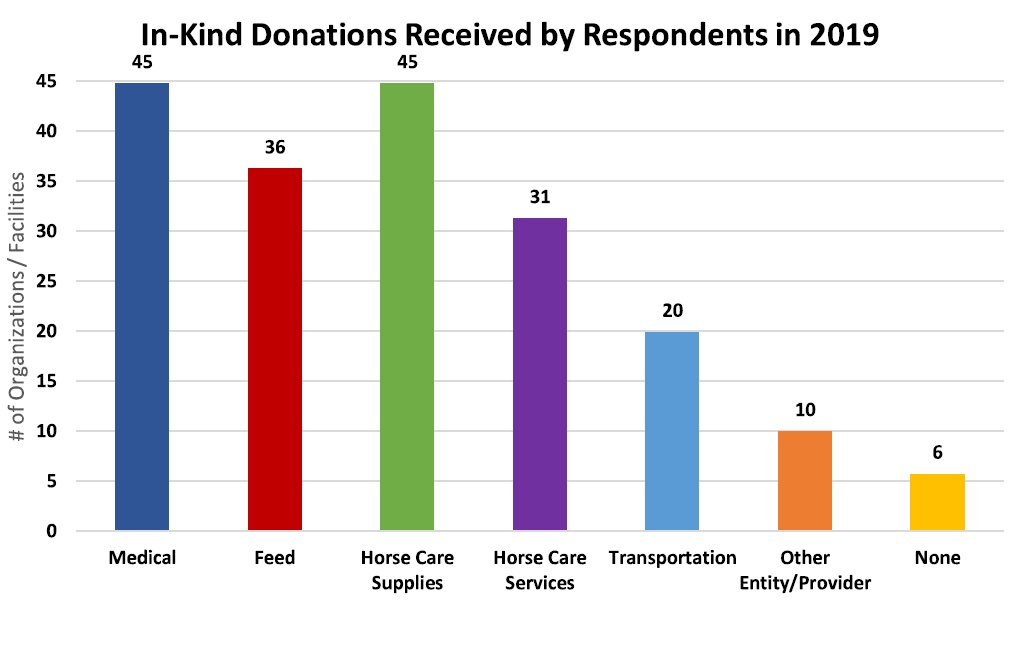
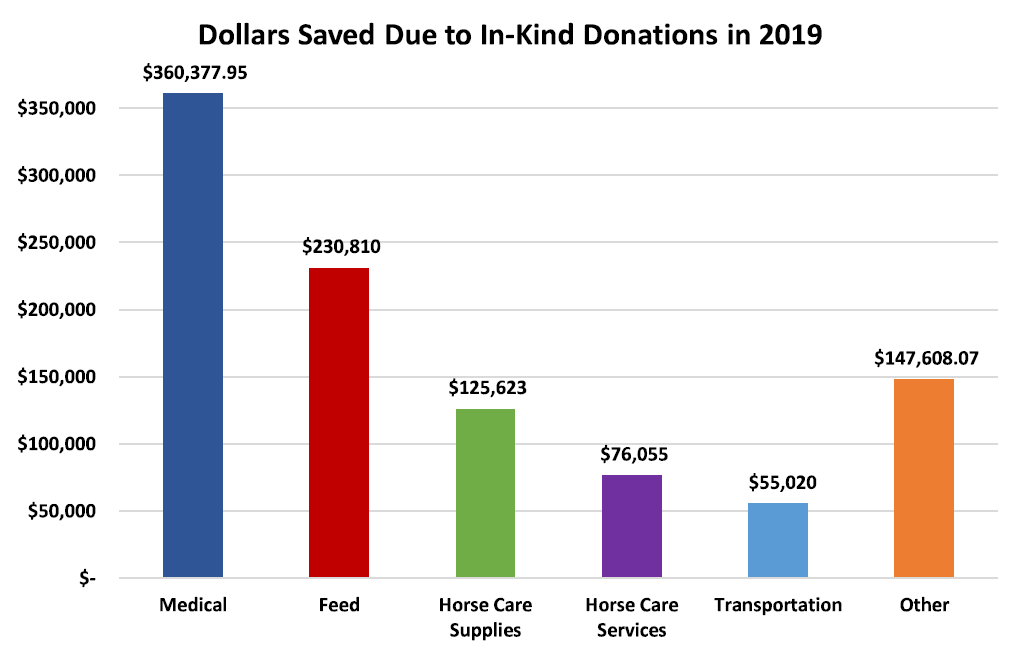
Sixty-nine organizations participated in the survey, representing 22 states, Puerto Rico, and Canada. Out of the participating organizations, 92% indicated that they received some form of in-kind donation in 2019. The total reported in-kind donations resulted in estimated savings of approximately $1 million.
Forty-five organizations reported receiving donations of medical supplies and services in 2019. Of those, 38 received free or discounted routine medical care, including dental care, vaccinations, and deworming.
In-kind donations of necessary medical supplies and services from veterinarians can help organizations save significantly, especially when those organizations are caring for large or aging herds. For TAA-accredited Old Friends Farm, their relationship with Dr. Bryan Waldridge and Park Equine Hospital is essential to the success of the organization.
“Dr. Waldridge has been our vet for about the last six years and he’s never sent us a bill,” Old Friends Founder Michael Blowen said. “Dr. Park (of Park Equine Hospital) is on our board of directors–anytime a horse needs anything they go to Park, and only under extraordinary circumstances do we receive a bill from them.”
Dr. Waldridge summarized the years of his time and resources he’s given to Old Friends as a rewarding opportunity to give back to the hardworking organization and its horses.
“You know, I don’t play golf and I’d like to fish more but working with these horses is one of my hobbies as much as anything,” Dr. Waldridge said. “I encourage all equine veterinarians to give back somehow because I think these types of organizations and the work the TAA does is a great way to do it. These horses, whether famous or not, they still gave it all and deserve a good retirement and a good life.”
Old Friends Chairwoman Cynthia Grisolia emphasized the impact of this generosity, which makes caring for nearly 200 retired racehorses possible.
“When you’re dealing with around 200 horses of advanced age, something happens every day. Whether it’s an abscess, scratch, or colic, veterinary care is basically a 24/7 need,” Grisolia said. “It is an absolutely vital service, not one that we can live without.”
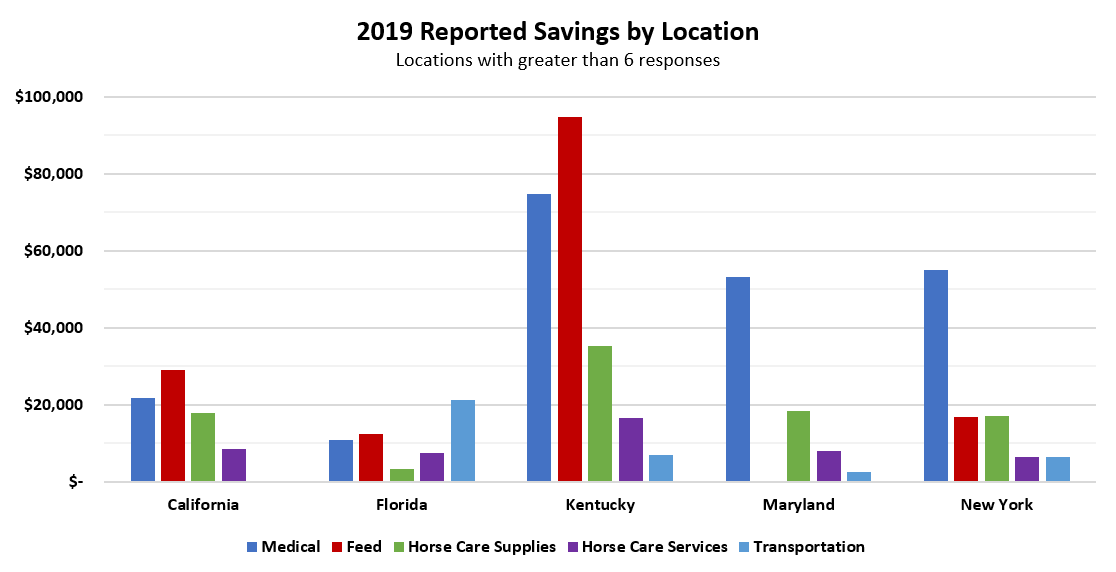
Veterinarians donating time, services, and/or supplies were reported by organizations in 19 states, Puerto Rico, Ontario, and British Columbia. East Coast organizations reported significant savings in medical donations. For organizations in New York and Maryland, the medical expenses category was where the most savings from in-kind donations was recorded. TAA organizations estimated a collective savings on medical expenses of more than $350,000.
In-kind donations of horse care supplies were also reported by 45 TAA-accredited organizations in 2019. The most reported donated items were fly masks and blankets (43 organizations reporting donations), followed by halters and lead ropes (37 organizations reporting donations).
The majority of these donations came from individual donors. In total, 44 out of the 45 organizations reporting horse care supply donations said the supplies came from an individual donor, someone who is not directly affiliated with a business. However, 18 organizations mentioned equine retail companies or businesses assisting with these donations as well.
For example, Laurie Calhoun, founder of The Foxie G Foundation, received donations of horse care supplies from a variety of sources around their equine community of Union Bridge, Maryland, including local tack stores, local riding stables, individual donors, and national retailers.
“The money that would go toward purchasing these things can now go toward other things to help the horses—maybe spend more money training a horse so it can be adopted, or for one of our sanctuary horses, who may need special supplements or equipment,” Calhoun said. “Every dollar saved, every hour saved is what we can put toward helping another horse and it adds up over the year. Time is probably our most precious commodity around here.”
Furthermore, Brook Hill Retirement Executive Director Jo Anne Miller attributes the vast amount of their organization’s in-kind donations across numerous categories to their willingness to support their local community and provide fair compensation.
“One of the things we do with our local tack shop is we have a business card with Brook Hill Farm and the name of the tack store, and anyone who brings in the card gets a 10% discount, so we are constantly sending people there,” Miller said. “They collect anything that’s not selling and used tack people want to donate and they bring it to us.”
The combined efforts of these donors helped TAA-accredited organizations in 16 states, Puerto Rico, and Ontario save approximately $125,000 in 2019 on horse care supplies.
Next, feed is the third highest in-kind donation category with 36 organizations in 15 states and one Canadian province reporting these donations. Twenty-six organizations received donations of grain and 17 organizations received donations of hay. The majority of these in-kind donations came directly from feed companies, with 28 organizations receiving supplies from this source.
For instance, Hope For Horses, a Northern California-based TAA-accredited organization, receives discounted feed from Elk Grove Milling, a local feed company as well as a nearby dairy farm that grows and sells hay. Hope For Horses Executive Director Anita Markiewicz attributes her organization’s donations to a good relationship with these local companies.
“The neighborhood that I’m in really lends itself to being a great community,” Markiewicz said. “One of the big dairies here grows hay. They provide hay out to other people and do hay sales. As a neighbor here, because we buy with such volume, he gives us a great price. Whenever the dairy is in need of moving hay from the previous year they give it to us at a discounted price so they can make room for the newer hay.”
“My neighbor directly behind me shares an easement and dirt road, he has a small 10-acre parcel that he grows hay and gives to me at a great price.”
In contrast to receiving donations directly from feed companies, New Vocations Racehorse Adoption Program receives a grant from a private foundation that covers their feed needs for their approximately 40-horse Lexington, Kentucky facility.
“Obviously it’s a major ongoing overhead cost that we would otherwise have to be spending significant donor dollars on, so it helps us be able to do more with less,” said Anna Ford, New Vocations Thoroughbred program director. “Knowing that the feed bill is covered, at least at that facility, allows us to use funding in other areas and helps the funding go further.”
In total, feed donations saved TAA organizations approximately $230,000. More than half of those donations came from feed companies that donated in-kind to California and Kentucky-based organizations, making feed donations the largest donation category by dollars saved for both states.
Representing another vital service, farriers donated their services to 26 TAA organizations in 2019. Organizations in 15 states, Puerto Rico, and Ontario reported saving approximately $60,000 in farrier services.
In particular, the Kentucky Horseshoeing School visits Old Friends Farm with a large group of students and instructors approximately every six weeks and provides a hoof trimming service for a majority of their residents for a small flat rate fee per day.
“It’s a win-win situation–we get lower priced farrier bills, we get very good work done, and their students are getting a lot of opportunity to practice and work on different kinds of horses,” Old Friends’ Grisolia said.
Lastly, 20 organizations were provided free or discounted transportation services. Of those, 19 organizations received assistance on short-distance transport and 11 organizations received assistance on long-distance transport. Shipping companies were the primary source of transportation donations, however, 11 organizations reported that individuals assisted with transportation needs.
According to Lisa Molloy, executive director of ReRun in Upstate New York, the organization works with several shipping companies and is often donated services if there is extra space on short-distance transports.
“It enables us to assist more horses in larger geographical regions without the financial implications, especially in this time, it’s quite important,” Molloy said. “We make a habit of when people adopt horses to recommend certain shipping companies that we are familiar with and we send them a lot of business.”
Specifically, Lukens Horse Transport, based in Ravena, New York works with and donates services to ReRun frequently, according to owner Jeff Lukens.
“We’ve been working with [ReRun] since they moved over there,” Lukens said. “Sometimes when they are busy we’re there every week, it just depends. Anything that [ReRun is] doing to help the horse, we want to do whatever we can to help also. Otherwise, the horses will end up somewhere in a bad situation. I think it’s important for the horses and their wellbeing because you know in the end that’s what we care about. We aren’t looking for any impact out of it, it’s just something we enjoy doing.”
Caribbean Thoroughbred Aftercare (CTA) in Puerto Rico faces geographical challenges unlike any other TAA-accredited organization. CTA Co-Founder Kelley Stobie works with numerous transportation companies including ground shipping in Puerto Rico and the contiguous U.S. as well as air transport, many of which provide a discount.
“Our situation is very different compared to other rescues because we’ve got to quarantine horses then fly them back to the U.S., so our operational expenses for travel can be quite a lot higher,” Stobie said. “If we get discounts and help from transporters in the mainland once the horses get there, then it makes a huge difference. The more discounts we get on anything, we raise we can use it for the next horse.”
An estimate of $55,000 was reported to be saved by TAA organizations in transportation expenses in 2019.
In-kind donations came from a variety of sources, with the majority attributed to the network of equine service providers and businesses in each organization’s local community. These vital donations from veterinarians, farriers, feed companies, equine shipping companies, individuals, and businesses help TAA-accredited organizations reach their high standards of horse care and sustain their operations so that more Thoroughbreds can be served. Thanks to the many donors, these organizations, their horses, and the larger aftercare community continues to thrive.